Stanford Discovery Could Lead To Cure For Deafness
Posted: 5:19 pm PDT May 13, 2010Updated: 6:50 pm PDT May 13, 2010
STANFORD, Calif. -- A new discovery from Stanford researchers may pave the
way for treatment -- and even a possible cure -- for deafness.
Stem cell scientists reported Thursday that they have for the first time
created in the laboratory the inner-ear cells responsible for hearing and
balance.
For the profoundly deaf, a risky and invasive cochlear implant is currently
the only way to restore hearing.
Doctors said in the vast majority of cases, the auditory nerve is intact.
But it's the inner ear that doesn't work.
"It's usually a loss of the sensory cells inside of the cochlea," said
Stanford Cochlear Implant Surgeon Dr. Nikolas Blevins. "And that is exactly
what a cochlear implant is designed to bypass."
Thursday's announcement suggests that there may be another way.
"It's a huge step forward for basic science," said Professor of
Otolaryngology Stefan Heller.
Professor Heller and his colleagues said the huge step is that they've
created the first functional cochlear sensory cells from stem cells.
Inside the spiral inner ear, there are only a few thousand sensory cells.
They do not regenerate once damaged by noise, virus or if genetically
absent. Deafness is permanent.
Scientists used mouse stem cells to create sensory cells that had a tiny but
critical hair bundle.
"This is a sensor which detects sound vibration and converts it to
electrical signal," explained Stanford researcher Dr. Kazuo Oshima.
"Fascinatingly, the cells were working which is a major step forward," said
Heller. "Eventually in the future possibly a cure for hearing loss."
Researchers cautioned that parents should not wait for this cure because it
could be a decade or more away. And while some people in the deaf community
applaud research, one summed it up to KTVU in a view not uncommon among deaf
people: "Why don't they quit trying to fix us.
Friday, May 14, 2010
Wednesday, March 17, 2010
CHOOSING A BRAND OF IMPLANT - Pulled from another blog (funnyoldlife.worldpress.com)
Choose a brand that is the best one for YOU.
What is a cochlear implant? Imagine you’ve bought yourself a new computer. The computer hardware is the implanted part of the cochlear implant (AB’s HiRes 90k, MedEl’s Pulsar & Sonata, Cochlear’s Freedom), the computer processor is the external speech processor (AB’s Harmony, MedEl’s Opus or Cochlear’s Nucleus 5), and the software is the programme which is adjusted through a series of mappings with the audiologist (AB’s HiRes Fidelity 120, MedEl’s FineHearing, Cochlear’s SmartSound). The cochlear implant companies bring out upgrades in the form of additional software to improve hearing functionality – such as AB’s ClearVoice which reduces background noise to provide greater speech clarity and ease of listening in noisy environments.
In the UK, you will usually be offered 3 cochlear implant brands to choose from;
MedEl
Advanced Bionics (AB)
Cochlear
You might be offered a fourth, Digisonic SP by Neurelec, which has been available since 2004.
Which one is the best? My cochlear implant team told me they were all the same. But are they? Remember, they are audiologists and surgeons, not electrical engineers. Plus, they’re not deaf, so they don’t have a personal interest in ensuring you are fitted with the best cochlear implant for you. Each brand has positives and negatives, in the implant electronics (which is the ultimate limiting factor in the stim that can be applied), the electrode array itself, the processor hardware, and the DSP software. The electronics in the implanted part are what you own; and any ability for processor hardware and software improvements on the outside for a better stim hinge on what the internal circuits can accurately yet quickly decode. Basically, it boils down to this: the processor is something replaced/upgraded every 3-5 years, and you do indeed need to live with it until the next upgrade comes out. The implanted electronics is something you’ll be living with for the next 20 years (or longer). Whatever level of technology in the stim you get when it’s switched on is what you’ll have to live with.
By a good margin, AB and MedEl have the best implant electronics with separate current sources for each electrode button. AB’s can fire 90k pulses per second on its 16 buttons simultaneously with both + .AND. – charges; MedEl can fire about 56k pulses (but simultaneously either – .OR. +) per second on its 12 electrodes; while Cochlear’s can only fire 30k pulses per second, and only one pulse at a time. This means AB has 128 virtual electrodes, MedEl has somewhere around 90 (but they don’t claim a number due to their triangular waveform)… while Cochlear only has 22, with an unapproved (in US) capacity of 43 with current shorting.
The physical electrode array itself is where the action is, especially if residual hearing is desired to be preserved. Here, MedEl is on top, while Cochlear is also rather good. That being said:
Preservation of residual hearing also greatly depends on the skill of the surgeon, with an overall average of about 65-70%. The best cochlear implant surgeon in the world is Rick Case at Washington University in St Louis (WUSTL) who has a 98% success rate, and John Niparko at Johns Hopkins University in Baltimore (JHU) is right with him.
Preservation of residual hearing is also subject to a third variable, besides manufacturer and surgeon: whether the electrode is placed perimodionally or floating. Perimodional (wrapped in a tight spiral around the core) placement puts the buttons closer to the nerves for a better stim with lower power and tighter focus (especially if current steering is enabled), and it also enables a deeper placement for a given length (tighter radius); but it also entails a higher risk to to residual hearing.
The processor hardware is important, as it entails both the number-crunching capacity of the chips needed for speech processing and digital noise reduction, and also the physical container:
On the processor capacity itself, all three are adequate for the stimulations that the implant electronics can deliver at present. That being said, the implant electronics for Cochlear is already stretched to capacity; while Dan estimates MedEl’s still has 5-7 years to go and AB’s at least a decade.
The physical packaging for the new Freedom 5 is rather good, with waterproofing technology borrowed from RION’s HB-54 series hearing aids; and being shrunk almost as small as the MedEl Opus2. With 50% of cochlear implants going into children (at least in the USA), Advanced Bionics’ relatively clumsy processor has turned off many parents and cochlear implant centres for infants and small children.
The DSP (Digital Signal Processing) software running in the processor is also important, as there are two main parts to it: the manipulation of the incoming sound across the frequency spectrum for noise reduction - or lack thereof for music - and the conversion of the processed sound into one of the various stimulation strategies (CIS, n-of-m (ACE), Hi-Res Parallel, Hi-Res Sequential, etc)… which is ultimately limited by the amount of memory and processing power of the electronics in the implant itself.
Audiologist Jo-Ann has programmed Advanced Bionics and Cochlear patients. The biggest thing she wishes recipients to know is that everyone’s brain is different. You cannot predict how you will do, so having a choice of processing or coding strategies is key. Just like with hearing aids, some people prefer the sound of Phonak some Oticon, etc. With AB, they have MPS, CIS, HiRes-S, HiRes-P, HiRes-P with 120, and HiRes-S with 120.
Audiologist Joanna has mostly dealt with Medel, 30% with Cochlear and 1 with AB. She says the implant itself is only part of the solution. Most of your work starts when the processor goes on and most of it is positive mental attitude coupled with lots of listening practice. The more you practice the better the discimination becomes. For some, clarity happens straight away – for others it takes time, so there is no easy answer.
Some people’s brains prefer the sound of HiRes-S vs HiRes-P because they stimulate differently. With Cochlear you really only have one choice. Cochlear patients cannot try out other strategies because there is only one power source. This is also what gives the audiologist flexibility in making a good program for you. Even if Cochlear has new software coming out; with one power source you are limited. Jo-Ann compares it to building a house with 22 rooms. If you only have one light switch you can turn all the lights on or all of the lights off. You need multiple power sources to turn off/on on each “room” individually. This is also why Cochlear rates are slower and they can get away with disposable batteries.
It’s always a great idea to contact each company and speak with one of their audiologists-ask as many questions as possible especially about the research and about the internal capabilities. It’s also great to find a centre that has done equal amounts of each company so they have a less biased opinion. The company audiologists are the ones that will be supporting your programming audiologist and helping your centre after you are implanted. Surgeons really only see you once a year and don’t know about the programming. Also they won’t know about the external returns or breakdowns. Another test for companies is to call their customer service line and see how fast you get hooked up to a real person. (Courtesy Jo-Ann, audiologist)
ADVANCED BIONICS
Check out AB Harmony v Nuke 5
AB’s is by far the leader in the implant electronics, with full current steering for 120 virtual electrodes from their 16 electrode buttons and HiRes speed delivering up to 90 thousand updates per second for the best stims, especially for music & for speech intelligibility in noise.
The downside to AB is in about 5% of implant surgeries because they only make two electrode arrays — The “antenna” that goes into your cochlea. Both the Helix, for perimodiolar placement, and 1J semi-curved, for lateral placement, work well… But not for everyone.
One of AB’s implantees, Mike Marzalek, is writing stimulation software to achieve better music enjoyment with his cochlear implant. It only runs on his special hand built speech processor. If successful, this will open the door to more people getting cochlear implants as you won’t have to be quite as deaf to get real benefit, not to mention faster & better aural rehab, which is often overlooked. Dan says,
While you’re on Mike’s site, be sure to view his biography page. Read the 6th paragraph; and if it doesn’t sink in, rinse and repeat until it does.
There are two other “CI Insiders” who are also guiding me; but what Mike has up his sleeve writing his own stim and testing it on himself as he goes along is the reason why I’ve chosen an Advanced Bionics implant.
This is in addition to AB’s ClearVoice noise reduction technology, now released in the UK (March 2010) and Canada (February 2010); but still awaiting FDA approval for release in the United States. That, coupled with Phonak’s buying of AB in September 2009 means that their 50 years of “front end” audio processing will be migrating to the next generation of BTE processors to be married up with the “back end,” the actual encoding of the signal for electrical hearing.
AB’s offerings are quite good; but they lack in one critical area: The electrode array itself. When it comes to preserving residual hearing, their older 1J semi-curved electrode in a lateral (hugging the outside wall) placement isn’t too bad, even though it was designed to be used with the positioner (which stopped being included after they resumed shipping c.2002). On the other hand, AB’s Helix array, which is designed for a perimodional (hugging the inside perimeter, close to the spiral ganglion) placement, makes hash as it’s threaded in.
Worse for AB is that AB’s chief electrode engineer, Janusz Kusma, was fired by CEO Jeff Greiner in a pissing contest, putting them years behind MedEl and even Cochlear when it comes to low insertion trauma.
Still worse, AB has no other offerings, such as compressed electrode arrays for partially-formed or ossified cochleas: You either get a 1J or a Helix array… Period.
AB’s processor is the largest of the three — about the size of the MedEl Opus 1.
MEDEL
MedEl is about 7 years behind AB on the electrode itself, with about 55,000 updates/second; but they only have partial current steering with their FineHearing; and an estimated 90 virtual electrodes with their triangular waveform. With the MedEl Sonata implant you’ll have 5-10 years of new stims still coming. Looking at size, the MedEl Opus2 processor is much smaller than the Nuke5.
The upside to MedEl over AB is their selection of electrodes for almost every type of cochlea imaginable; and custom built electrodes that nobody else can do.
There is quite a bit of antipathy about MedEl. The issue is in the surgical placement of the electrode into the cochlea itself; and although there are similarities, there are also wide differences, especially when attempting a perimodional (vs lateral) electrode placement when threading it into place. What you want, especially for the tricky perimodional placement while trying to preserve residual hearing, is a surgeon with a lot of experience with that cochlear implant brand. MedEl’s processor and implant electronics are almost as good as AB’s; and their variety of electrode arrays is as good as, maybe even better than, Cochlear’s.
COCHLEAR
Bringing up the rear (from the implant electronics technology, working outwards) is Cochlear. They are hopelessly buried by competitor AB and MedEl patents. Because of this, even though they have a slick new Nucleus 5 BTE w/remote, they are still limited to the same 30,000 updates per second as they were over a decade ago. And, even though they have 22 electrode buttons, the best they can do is 43 virtual electrodes with current shorting — and they still haven’t released it yet!
The Nuke is about the same as MedEl’s CI from 2006. Cochlear has almost nothing new. They have a huge marketing budget though so beware, not all that glitters is gold….
There is one area where the Nuke 5 is worth a very long, careful look: children. Even though the implant electronics are obsolete, the implant itself is quite robust (or at least previous Nucleus implants are), and with infants and small kids they can’t tell you if it’s not working properly. The Freedom 3G processor has a fingernail-sized LCD status display on it; while the Nuke has a dual purpose (and bidirectional) remote control that also is a status indicator, duplicating the processor’s LED status lights. This is handy because a parent or teacher can simply walk up to the child with the remote, push a button, and get instant feedback from the processors and implants. This can be helpful when the parents themselves aren’t diligent in watching their children’s hardware.
SUMMARY
Best hearing performance – Only recently have independent comparative studies been published, and AB came out on top in all of them.
Best reliability – All manufacturers claim +99% reliability for the implant, but only AB includes the external processor in the calculation. AB doesn’t make a big deal about water resistance, but their warranty does cover water damage. Cochlear makes claims about water resistance, but their warranty does not cover water damage.
Best upgradeability – AB’s HiRes 90k uses about 25% of its capabilities. Cochlear’s implant is pretty much tapped out, while Med-El’s is somewhere in the middle. The implant is the part you plan to keep for a very long time.
The T-mic – MedEl and Cochlear have their mikes on top of the ear, like BTE hearing aids. But AB has the mike at the tip of the ear hook, which is right at the entrance to the ear canal. This means your ear shapes the sound normally. Most users find this works much better than the BTE mike (which is also included, and is selectable in software). And you can use phones and headphones just like a hearing person. It’s patented, so the other manufacturers can’t put the mike there.
Miniaturization of processors – AB was purchased by Sonovus, the holding company of Phonak, in January 2010. This means that AB is the only company with access to the super miniaturization technology and years of experience of a hearing aid company. And Phonak is among the best. While AB’s processor isn’t currently the smallest, look for excellent features down the road.
INDEPENDENT STUDIES
Spahr et al EH 2007 compares performance of cochlear implants from Advanced Bionics, Med-El and Cochlear.
Audiology Online: “Preliminary Comparison of Performance between Patients Fit with the CII Bionic Ear and Patients Fit with the Nucleus 3G.” M. Dorman (Arizona State University), A. Spahr (Arizona State University) and K. Kirk (Indiana University School of Medicine), June 2003
In an independent study supported by NIDCD grant and contributions from all cochlear implant manufacturers, researchers compare performance between adults who use HiResolution sound and those who use the Nucleus 3 System. Results from the study’s first reported findings indicate that there “are differences in performance between patients using the two implant systems.” “Significant differences in performance (p <>
With thanks to (1) Surgeons Dr Lavy and Prof. Saeed, speech therapist Liz Stott (2) Dan Schwartz, a deaf electrical engineer formerly in the hearing healthcare business – he is about to get a CI. (2) Jo-Ann, audiologist (4) Joanna Nicholson, audiologist (4) Howard Samuels, BEA Mentor (5) Advanced Bionics, Med-El, Cochlear.
Tuesday, March 09, 2010
My baby is 8

Time has flown by and now Jack (my baby) is 8 years old. It has been a time of reflection for me on how far Jack has come. From the start when we found out he was born deaf(six weeks old) , to unuseful hearing aid trial (declining loss - 18 months) , cochlear implantation (21 months) , bi-lateral cochlear implantation (31/2 years) , implant failure (4 years) , diagnosis of Jack having severe apraxia (4 years), to today. What a whirlwind it's been....I'm exhaused.... But what a blessing it has all been to me.
I went through a major greeving period after Jack was diagnosed. He was not my "perfect" baby...he was flawed. This was how I felt. I did not understand how or why this could be happening to me, to him! I look and do not see Jack as flawed at all, he is a remarkable, intelligent, fun, caring, loving, funny, handsome, friendly, fearless boy that I love. All of these issues has made Jack who he is. I would never change a second in time if it would change the boy I know and love today.
I have learned that life still holds challenges for my son, but they are challenges I know he has the skills to handle. In this too, I have learned that I can handle challenges that come my way too and that I am a very strong person. We are both strong for this life learning experience....thank god for this experience. I am blessed.
Friday, December 18, 2009

Tuesday, August 25, 2009
Hello all its been a very long time since my last post.
Just wanted to update on Jack's great Audiology Apt recently. His scores were as follows....and this was with severe apraxia....by the way!!! We were all very happy.
Nu-Chips - (Right CI) MLV/45db Word Score 25/25
Nu-Chips - (Left CI) MLV/45db Word Score 24/25
MLNT Easy #1 (Right and Left CI) Word Score 92% Phoneme Score 98%
MLNT Hard #1 (Right and Left CI) Word Score 92% Phoneme Score 98%
PBK#2A - (Right CI) Word Score 72% Phoneme Score 89%
PBK#2A - (Left CI) Word Score 80% Phoneme Score 90%
PBK #1A - (Right and Left CI) Word Score 92% Phoneme Score 97%
As you can tell on the PBK testing Jack score much higher with both implants on. Another clue that two ears are better than one! Hurray for bi-lateral hearing.
Just wanted to update on Jack's great Audiology Apt recently. His scores were as follows....and this was with severe apraxia....by the way!!! We were all very happy.
Nu-Chips - (Right CI) MLV/45db Word Score 25/25
Nu-Chips - (Left CI) MLV/45db Word Score 24/25
MLNT Easy #1 (Right and Left CI) Word Score 92% Phoneme Score 98%
MLNT Hard #1 (Right and Left CI) Word Score 92% Phoneme Score 98%
PBK#2A - (Right CI) Word Score 72% Phoneme Score 89%
PBK#2A - (Left CI) Word Score 80% Phoneme Score 90%
PBK #1A - (Right and Left CI) Word Score 92% Phoneme Score 97%
As you can tell on the PBK testing Jack score much higher with both implants on. Another clue that two ears are better than one! Hurray for bi-lateral hearing.
Wednesday, November 12, 2008
What a Great Year!!!

Jack is making such great strides in regards to his apraxia. His hearing if you can believe it is actually his strength, thanks to his implants.
I just had Jack's parent teacher conference and his is doing quite well, better than I expected. He is keeping up in math and his teacher says that his patterning is at the highest level they test so far this year. Yea!! He is quite the little artist too.
He is getting so much better with his speech and his teachers have noticed a big improvement from last year. He still has some word retrieval issues associated with his apraxia, but it is getting much better with training. No we see as things have been sorted out that he infact, does not have memory issues and it is all do to his filing cabinet (brain) and the things he wants to say have not been in the right place for him to grab. Finally, there is a light at the end of the tunnel.
Jack is still having some issues with speech errors, but those too are finally being sorted out and his is speaking wonderfully.
Finally, I can now sit back and relax a bit........Jack is progressing and progressing well. He is even keeping up in school!
The picture above is from our summer vacation. Ahh....summer....please come back!!!
Tuesday, October 07, 2008
Totally Implantable CI's In Our Future?! YES!!!
I just read an article on completely implantable Cochlear Implants. I am very excited to see what the future will hold for all CI's users. Just to think that my son will one day be able to hear in the pool, shower, while sleeping........ Never to be without sound is amazing. No more stress of being invited to pool parties! One day this will be available and hopefully soon......
http://www.citeulike.com/user/thenose/article/3318698
http://www.citeulike.com/user/thenose/article/3318698
Tuesday, April 29, 2008
Progress Notes

Hello All, It's been along time since my last post and I felt I should give an update. Jack has made the biggest gains this year and it is a miracle to us. Jack is finally getting good control over his speech and working on increasing his sentences. His ablitlty to be understood also has increased. He still has the diagnosis of Apraxia, but I have been told by his therapist that one day (hopefully soon) he will be free of his diagnosis.
As I have said in earlier posts, hearing is not Jack's main issue anymore. Yes, he is deaf and wears a cochlear implant, but he hears and is able to reproduce any sound as a hearing child with beautiful sound quality. Jack can hear me when he is upstairs or in the other room and we can talk back and forth and he has hearing friends that he communicates verbally with. The implant is a wonderful miracle, and that I can see hearing is not an issue is beyond what I could have ever imagined when Jack was first diagnosed.
We are still working hard with Jack, but Jack's progress this year has been the biggest of his life so far. Jack is a spirited young boy and able to do anything he sets his mind too. We are blessed to have such a wonderful caring team behind us and helping our son.
Tuesday, June 05, 2007
Harmony Processor

Jack is now using the Harmony processor! We are very lucky that when he had a internal device failure (vender b) Advanced Bionics upgraded Jack to the Harmony processor for free, on both ears. We are all loving the new features of longer battery life. Jack can now go about 11 -12 hours without changing his batteries it is so nice to not have to think about that like we used to. Jack can now go to school all day without having to change his batteries and they are the SLIM size batteries too!! Also, having the light to let us know if something is wrong is nice too. Jack is not using the 120 programming yet, but I'm sure we will be upgrading to that when it is available. The new t-mic hook is something you should try also. It is much smaller than it used to be and is available now. It can be used on all processors.
Jack is also making such great progress in his speech, finally! We have found Jack's missing link into why he was so far behind in his expressive language. Getting him help with his apraxia has made a tremendous differnence. Jack is now starting to put 3-4 word sentences together and they are getting clearer by the day. A prayer has been answered!
Picture is from Jack at school last month.
Jack is also making such great progress in his speech, finally! We have found Jack's missing link into why he was so far behind in his expressive language. Getting him help with his apraxia has made a tremendous differnence. Jack is now starting to put 3-4 word sentences together and they are getting clearer by the day. A prayer has been answered!
Picture is from Jack at school last month.
Wednesday, April 18, 2007
Another Sucessful Surgery
Yea, surgery is over and we are back home. Jack had his re-implantation yesterday and the surgery went great. The surgeon got full insertion again, and said it was "test book". Jack is at home and resting (trying to get him to rest) and doing great. These kids bounce back so fast it is unbelievable. Jack's turn on is scheduled for May 2nd....can't wait to get things back to normal again.
Jack is doing so well with his "newer" ear since his failure. I can't believe that he is caught up without doing much individual work with that ear. He has not missed a beat and has attending speech and school without any problems. I have notice a big difference in hearing with background noise, but other than that he has done great. I recommend bilateral implants to all families out there. I don't know what we would have done if Jack would have been completely off air for the last 3 weeks......
Jack is doing so well with his "newer" ear since his failure. I can't believe that he is caught up without doing much individual work with that ear. He has not missed a beat and has attending speech and school without any problems. I have notice a big difference in hearing with background noise, but other than that he has done great. I recommend bilateral implants to all families out there. I don't know what we would have done if Jack would have been completely off air for the last 3 weeks......
Thursday, March 29, 2007
AB Failure after 3 Years
After 3 years of hearing out of his right side my son has now lost that hearing due to a device failure. We just had it confirmed yesterday by his Audiologist. I thought that this might have been happening a little at a time for the last month or so because Jack would complain that it would go in and out.
Jack is scheduled for reimplantion in 2 weeks so I will post on the outcome. They said it will take Jack a couple of weeks to a month to get back to where he was again on that side.
On a positive note Jack will receive that upgraded Harmony processor which I am happy about. I thought we would be fighting insurance again soon for the upgrade, I'm glad I will not have to deal with that now.
Another thing I am thankful for is Jack is BILATERAL!!! What would I be doing now if he wasn't. He does not know sign language and I don't know how to deal with him any other way than though speech. I think about how Jack would be with a device failure and not hearing at all for a month!!! Jack really was upset when it first happened, but now is going about his day and not really missing a beat. He saw his SLP yesterday and actually had a great session and he will be going to school this afternoon. This is another reason why bilaterals are such a benefit....you have a backup!!! That makes it all worth it alone, not to mention the other incredible benefits!!!!!
Jack is scheduled for reimplantion in 2 weeks so I will post on the outcome. They said it will take Jack a couple of weeks to a month to get back to where he was again on that side.
On a positive note Jack will receive that upgraded Harmony processor which I am happy about. I thought we would be fighting insurance again soon for the upgrade, I'm glad I will not have to deal with that now.
Another thing I am thankful for is Jack is BILATERAL!!! What would I be doing now if he wasn't. He does not know sign language and I don't know how to deal with him any other way than though speech. I think about how Jack would be with a device failure and not hearing at all for a month!!! Jack really was upset when it first happened, but now is going about his day and not really missing a beat. He saw his SLP yesterday and actually had a great session and he will be going to school this afternoon. This is another reason why bilaterals are such a benefit....you have a backup!!! That makes it all worth it alone, not to mention the other incredible benefits!!!!!
Thursday, March 08, 2007
Jack Turned 5

Here is a picture of Jack blowing out his candles. I can't believe he is 5 already.....where has the time gone.
Wednesday, March 07, 2007
Jack Making Great Strides in Language!

Wow it has just been a month since we have been seeing a speech pathologist for Jack's apraxia and it is paying off. Jack has really made great strides in his speech and his intelligibility. I feel a prayer has finally been answered!
His teacher even reported that she is really noticing a difference.
Jack has been so responsive to the new therapy that they have now diagnosed his apraxia as a mild case because he is moving along so rapidly.
His teacher even reported that she is really noticing a difference.
Jack has been so responsive to the new therapy that they have now diagnosed his apraxia as a mild case because he is moving along so rapidly.
Here is a cute picture of Jack at school. I will keep updating on Jack's progress.
What about Brian
DISREGARD MY FIRST POST REGARDING THIS SHOW!!
I am so upset by where the What about Brian storyline has gone. Just recently a little 12 month old underwent implant surgery on the show. I really thought this story line was going to educate the public on the miracle we have all had in our lives, the Cochlear Implant. I just wrote a complaint to ABC and I would ask you all to do the same. http://www.abc.com/ I think they should give a service announcement at the end of the next show saying that the information that they gave in the last show was inaccurate.
Thank you!
I am so upset by where the What about Brian storyline has gone. Just recently a little 12 month old underwent implant surgery on the show. I really thought this story line was going to educate the public on the miracle we have all had in our lives, the Cochlear Implant. I just wrote a complaint to ABC and I would ask you all to do the same. http://www.abc.com/ I think they should give a service announcement at the end of the next show saying that the information that they gave in the last show was inaccurate.
Thank you!
Tuesday, February 13, 2007
Jack has Apraxia
We have been in AVT since Jack has been 41/2 months. He received his CI at just under 2 years old and was bilateral implanted this past May. Jack's understanding has always been ahead of his verbal abilities and now we know why.
Jack was recently diagnosed with Verbal Apraxia. He has started seeing an Speech Pathologist that has worked with a lot of kids with Apraxia. She said she is impressed with what a good foundation Jack has and that is due to all the AV Therapy he has had over the years.
Jack has been to the speech pathologist only once and I have already notice a difference in a week. She gave us exercises to work on his "p" and now he is able to say the "p" and is even realizing when he switches it out with a "t" as he did before. I'm very excited that we have finally found the reason for all of Jack's struggles. I just wish we would have known sooner that this is what it actually has been all along.
We had been working with a Oral Motor Specialist since October and I think she has helped, but I really believe that this was not the main factor to him being unable to put things together. The Speech pathologist said that Jack has enough oral motor to make speech. I don't know if it has been all the work we have done since October, or if was never really a factor. He never had a eating issue and he was able to do tasks with his mouth when we asked. I really have felt like a piece of the puzzle has been missing and now it has been found.
I will keep you all up to date on Jack's progress.
Jack was recently diagnosed with Verbal Apraxia. He has started seeing an Speech Pathologist that has worked with a lot of kids with Apraxia. She said she is impressed with what a good foundation Jack has and that is due to all the AV Therapy he has had over the years.
Jack has been to the speech pathologist only once and I have already notice a difference in a week. She gave us exercises to work on his "p" and now he is able to say the "p" and is even realizing when he switches it out with a "t" as he did before. I'm very excited that we have finally found the reason for all of Jack's struggles. I just wish we would have known sooner that this is what it actually has been all along.
We had been working with a Oral Motor Specialist since October and I think she has helped, but I really believe that this was not the main factor to him being unable to put things together. The Speech pathologist said that Jack has enough oral motor to make speech. I don't know if it has been all the work we have done since October, or if was never really a factor. He never had a eating issue and he was able to do tasks with his mouth when we asked. I really have felt like a piece of the puzzle has been missing and now it has been found.
I will keep you all up to date on Jack's progress.
Friday, January 26, 2007
What about Brian
This past Monday on "What about Brian" there was an episode about a young couple making a decision on weather to implant their almost 12 month old daughter. This story line should be very interesting, especially for us with implanted kids. I'm so glad there is a show out there that is addressing this issue. The more information brought to the public the less harder it will be for our children to break free from any preconceived stereo types of the past. You can watch the episode from January 21st on http://www.abc.com/ This is definitely a story line to watch!!!
FYI, there is also another implant story on televison on "The Young and the Restless". An older boy who caught menengitis has recently been implanted. I don't watch it but I believe it is Dru's son. Check it out!
FYI, there is also another implant story on televison on "The Young and the Restless". An older boy who caught menengitis has recently been implanted. I don't watch it but I believe it is Dru's son. Check it out!
Wednesday, January 17, 2007
Happy New Year - Update on Jack
Jack has now been implanted for almost 3 years with his first implant. He has had his bilateral implant for 7 1/2 months. I have noticed so much improvement on Jack's listening since his bi-lateral. He is so much more in tune with what is being said and picking up incidental speech like crazy. Yesterday, I was in the kitchen and Jack was in our office which is quite a distance away. I called his name and I heard him in the office say "what". It is amazing how well Jack is hearing....it's a miracle.
Jack is doing well with his overall understanding, but is still behind in his ability to use his words well. We had Jack evaluated by a oral motor specialist this past October and we found out that Jack is having some sensory issues with his mouth. We have been working on his oral motor issues since October and I have notice a difference in the last few weeks. He really is adding more words to form more complete sentences. He is still having troubles forming his B's and P's, but his M's are coming around. I know that this is why Jack has not progressed in his verbal abilities and I can't wait to see what this year is going to bring for him as we finally resolve this problem.
Jack is still attending AVT twice a week, oral motor once a week and Montessori Pre-school half day, everyday.
Happy New Year to all of you!
Jack is doing well with his overall understanding, but is still behind in his ability to use his words well. We had Jack evaluated by a oral motor specialist this past October and we found out that Jack is having some sensory issues with his mouth. We have been working on his oral motor issues since October and I have notice a difference in the last few weeks. He really is adding more words to form more complete sentences. He is still having troubles forming his B's and P's, but his M's are coming around. I know that this is why Jack has not progressed in his verbal abilities and I can't wait to see what this year is going to bring for him as we finally resolve this problem.
Jack is still attending AVT twice a week, oral motor once a week and Montessori Pre-school half day, everyday.
Happy New Year to all of you!
Friday, January 05, 2007
Jack in New Advanced Bionics Calendar

Advanced Bionics has just issued it's 2007 calendar. Jack did make it in this years calendar, his picture is in February. It is a fantastic calendar and I look foward to seeing all the kids pictures and reading there comments. If you would like a copy of the calendar you can log onto Advanced Bionics web page and request one. On the side of this posting you will find a link to Advanced Bionics. Have a Happy New Year!!!!
Monday, November 27, 2006
Happy Thanksgiving
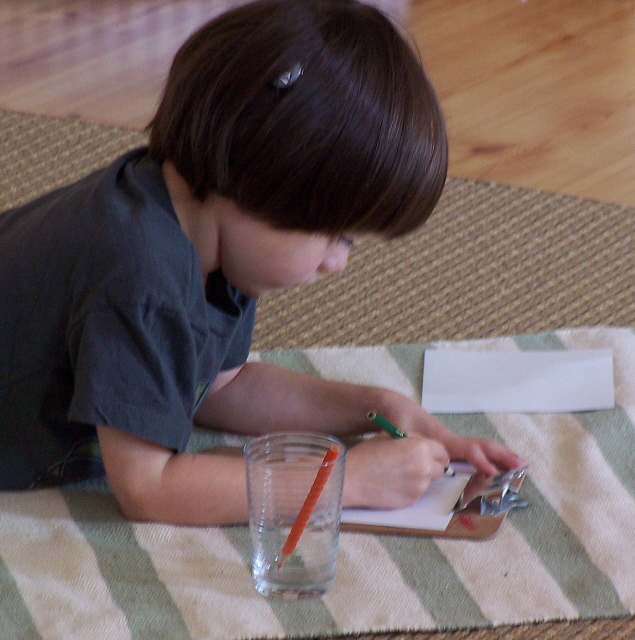

We have so much to be thankful for this year. Jack is doing well in school and we had very positive comments at his parent-teacher conference. Jack's understanding is increasing so much he loves numbers and counting! Jack is still behind in his expressive communication, but with the amount he has in understanding it is only a matter of time when it will all come pouring out! Jack has a very "head strong" personallity which has never been to his advantange....hopefully it will be in the future! Here is a picture of Jack at school. Jack attends a montessori pre-school. I would highly recommend this type of schooling for any child.


Thursday, October 26, 2006
CI- Circle
I wanted to tell everyone about a great online support group for parents of children with cochlear implants. I have been a member for two years have gotten so much great advice from other parents that are going throught the same things that we are. I actually enjoy talking to other familys and giving my advice also. If you are a parent of a newly diagnosed child and would like to talk or get information please sign up for this yahoo group. You can register at yahoo groups - ci circle.
Subscribe to:
Posts (Atom)